
Someone in Johannesburg has a burst pipe and searches Google for a plumber. Someone in Harare needs an accountant before tax season closes in. A homeowner in Bulawayo is trying to find an electrician who’ll actually pick up the phone.
None of these people are browsing. They have a problem and they’re looking for someone to solve it right now.
Will they find your business, or will they land on your competitor’s website instead?
That’s really what local SEO comes down to.
Local SEO helps your business show up when people nearby search for what you do. Whether you run a plumbing company in Johannesburg, a salon in Pretoria, a law firm in Harare or a construction business in Bulawayo, showing up in those local searches can turn into real enquiries.
This guide covers what local SEO actually means, how it works, and why it’s worth paying attention to if you’re growing a small business.
What Is Local SEO?
Local SEO, or local search engine optimisation, is the work of improving your online presence so your business has a better chance of showing up when people search for what you offer in a specific area.
Think about searches like:
- Plumber in Johannesburg
- Accountant in Harare
- Electrician near me
- Web design in Pretoria
- Best restaurant in Bulawayo
Google tries to match these searches with businesses that are actually relevant, and where it applies, actually nearby.
To do that, it looks at a few things: what your business does, where it’s based or which areas it serves, how relevant it is to the search, and whether it looks like a legitimate, established business. Your website, your Google Business Profile, your reviews, and how consistently your business information appears across the web all feed into that picture.
A simple example
Say you run a web design company serving parts of Johannesburg.
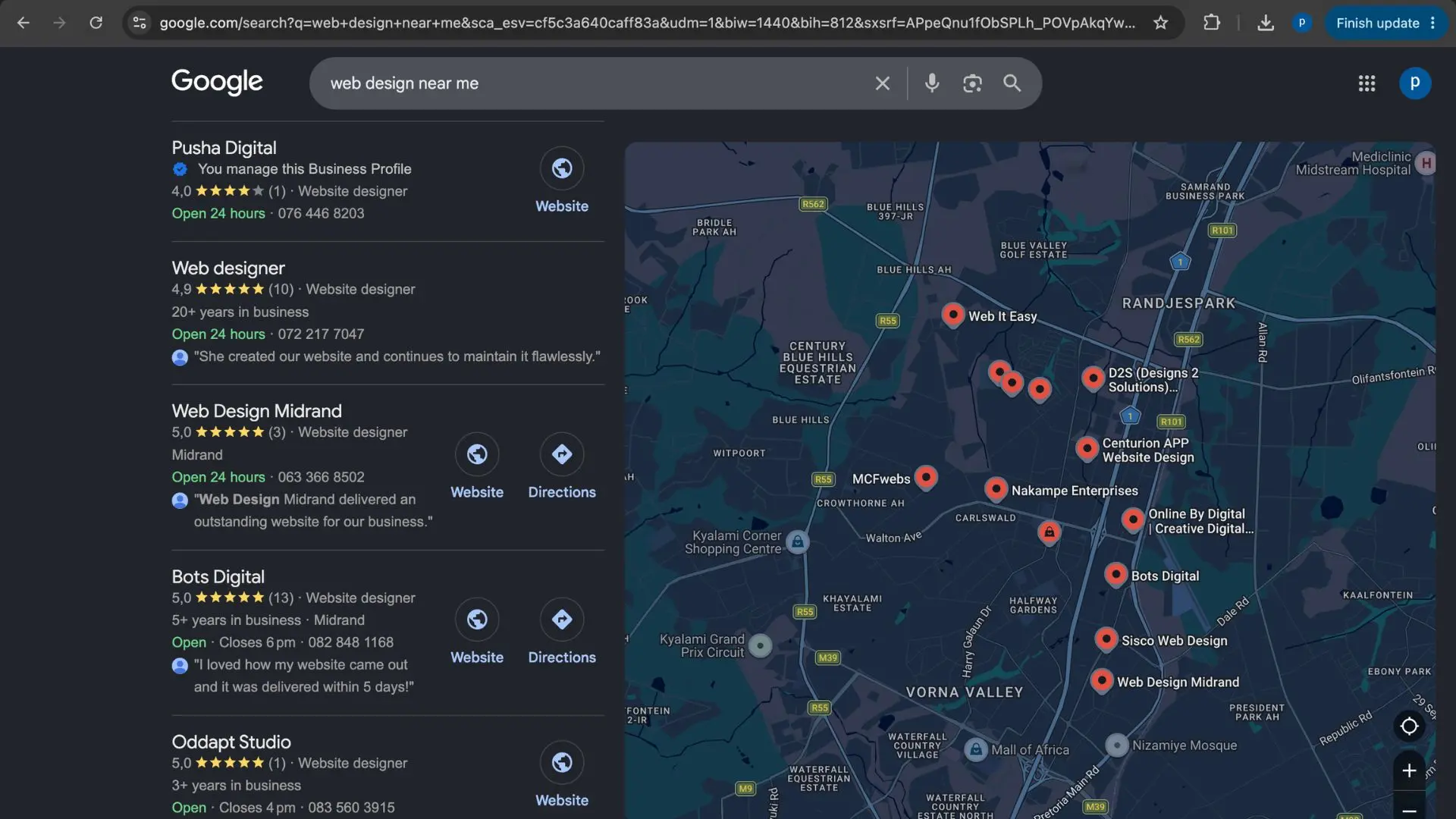
When someone searches “web design near me” or “web design in Johannesburg,” there could be dozens of businesses competing for that same spot. Local SEO is really just about making it obvious to Google, and to the person searching, what you do, who you do it for, and why you’re worth trusting.
The clearer that picture is, the better your odds of getting noticed.
How Does Local SEO Work?
There’s no single trick that puts a business at the top of Google. It doesn’t work that way.
Google weighs a number of factors when deciding which local results to show, but three come up again and again: relevance, distance and prominence.
Relevance: does your business match what the customer is searching for?
This is about how closely your business lines up with the search itself.
If someone searches “WordPress web designer in Pretoria,” Google needs a way to work out which businesses actually offer that service, to that kind of client, in that area. That means your website needs to say, clearly, what you do, who it’s for, and which areas or problems you cover.
You don’t need to stuff a long list of cities onto every page to achieve this. What actually helps is content that genuinely explains your services and where you offer them. A business covering Johannesburg, Pretoria and the surrounding areas might have a few well-written location pages, but only where those pages add something real.
Distance: where is the customer searching from?
Location shapes what people see, even when they’re searching for the exact same thing.
Two people searching for “restaurant” from different parts of the country won’t necessarily see the same results. Someone in central Johannesburg will likely see different options to someone searching from Pretoria.
This matters most for businesses with a physical location, or ones that serve a defined patch of territory. And it’s worth saying plainly: you can’t just tack a city name onto your homepage and expect to rank there. Your actual presence, your reviews, your listings, needs to back that up.
Prominence: how established does your business look online?
Prominence is roughly a measure of how well-known or credible your business appears to be. Reviews play into it. So do mentions of your business elsewhere online, links from other sites, and the overall footprint you’ve built.
For a small business in Harare, Johannesburg, Pretoria or Bulawayo, this tends to build slowly. There’s no shortcut worth taking here, just steady, genuine effort over time.
Where Can Your Business Appear Through Local SEO?
Most people think local SEO starts and ends with Google Maps. It’s a big part of it, but not the whole picture.
Google Maps
Google Maps helps people find businesses nearby when they search for something specific, like “plumber near me” or “coffee shop in Pretoria.” If your business qualifies and your profile is properly set up and maintained, this can be one of your strongest sources of visibility.
Local business results in Google Search
For some searches, Google shows a cluster of local businesses alongside a map, right near the top of the page. These results catch people at the exact moment they’re looking for a local solution, which makes them worth paying attention to.
Your website in organic search results
Your website can also rank on its own, separate from any map listing. Someone might search “affordable web design in Johannesburg” or “SEO agency in Harare” and land on your site through the regular organic results.
A solid local SEO approach should cover both: your visibility as a local business, and your website’s ability to rank on its own merits.
7 Ways Local SEO Can Help Your Small Business
1. More local customers can actually find you
People don’t ask friends for recommendations the way they used to. Increasingly, they just search Google when they need a plumber, a lawyer, an accountant, a web designer, an electrician, a cleaning company, a dentist, a builder.
If your business barely shows up online, you’re missing out on a lot of those moments. Local SEO is simply about improving your odds of being there when people search for something you actually offer.
2. The enquiries you get tend to be more relevant
Not all traffic is worth the same. A thousand visitors scattered across the globe might do less for a Johannesburg plumbing business than ten people nearby who genuinely need a plumber today.
That’s the real value of local search traffic: it’s people whose search already has something to do with what you do and, often, where you’re located.
3. Better visibility across Search and Maps
A local customer might come across your business in more than one way, through your Google Business Profile, your website, a specific service page, a review someone left, or an article that answered a question they had.
It’s rarely about ranking for one keyword. A stronger local presence just gives people more chances to bump into your business and decide it’s worth a call.
4. Trust starts building before they even contact you
People do their homework before they pick up the phone. They’ll look at your reviews, your photos, your website, what services you offer, how long you’ve been around, whatever they can find.
Picture two electricians in Pretoria offering the same service. One has a half-finished website and barely any information online. The other clearly lays out what they do, has decent reviews, and looks like a real, active business. Even before a customer says a word to either of them, they’ve already formed an opinion.
5. It lets small businesses compete without going head-to-head with everyone
You don’t need to outrank every business on the planet. A local electrician in Bulawayo mostly needs to be visible to people looking for electrical work in the areas they actually serve.
A focused local SEO strategy lets a smaller business put its energy where it counts, rather than chasing broad, highly competitive terms it has little chance of winning. That said, competition still exists. In busier markets like Johannesburg or Pretoria, you’ll likely need a more consistent, sustained effort to hold your ground.
6. It can continue bringing in traffic over time
Paid ads bring in traffic for as long as you’re paying for them. Once the budget stops, so does the visibility.
SEO tends to behave differently. A well-built page targeting a service in Harare can keep attracting relevant searches long after you’ve published it, though rankings do shift over time and nothing runs entirely on autopilot. That’s one reason a lot of businesses pair SEO with other marketing rather than betting everything on one channel.
7. It makes life easier for the customer, not just for Google
Good local SEO isn’t only about rankings. It’s also about making sure a visitor to your site can quickly work out what you do, where you operate, how to reach you, and why they should bother.
Nobody wants to dig through five pages just to find out if you actually serve their area. Clear, upfront information helps the person reading it, and it happens to help search engines understand your business too.
What Are the Main Parts of a Local SEO Strategy?
Local SEO isn’t one task, it’s a handful of things working together.
Google Business Profile. If your business is eligible, keep this accurate and current: business name, category, contact details, website, hours, services, and service area where relevant. It’s often the first thing a potential customer sees, so it’s worth getting right.
Local keyword research. This is just about understanding how people actually phrase their searches. Someone might search “SEO company in Johannesburg,” another might type “affordable website design Pretoria,” and a third might simply search “web designer near me.” You’re not trying to cram every variation onto one page, you’re trying to understand the language your customers actually use.
Service pages. Each important service deserves its own page that explains what it is and how it helps. A digital agency, for instance, might have separate pages for SEO services, local SEO, WordPress web design, and Google Business Profile optimisation, rather than lumping everything onto one generic page.
Location pages. These are useful when a business genuinely serves a particular area, not as a box-ticking exercise. If a business is actively working with clients in Johannesburg, Pretoria, Harare and Bulawayo, a page for each market can help, but only if each one offers something real. Four pages that are identical except for a swapped-out city name don’t help anyone, least of all the person reading them.
On-page SEO. This covers the more technical, on-the-page side of things: titles, headings, content, internal links, images, and making sure the location relevance is clear where it matters.
Customer reviews. Genuine reviews build trust in a way that’s hard to fake convincingly, and Google notices too. Fake or bought reviews are a bad trade-off; they might help briefly, but they tend to unravel.
Local citations and business information. A citation is simply a mention of your business details, name, address, phone number, website, somewhere online. Keeping these consistent across directories and platforms helps avoid confusing potential customers, and it helps Google trust the information too.
Links and mentions. When a local directory, industry publication, community group or partner links to your business, that adds to your credibility. It’s better to earn a handful of relevant, genuine mentions than to chase as many links as possible.
What Types of Businesses Can Benefit From Local SEO?
Local SEO tends to matter most for businesses that rely on customers in a specific area: plumbers, electricians, builders, roofing companies, cleaning companies, lawyers, accountants, restaurants, salons, medical practices, car repair shops, real estate professionals, web design agencies, marketing agencies.
A plumber in Johannesburg has no use for traffic from someone thousands of kilometres away. They need to be found by people looking for plumbing help in Johannesburg, or wherever they actually work. The same goes for a law firm in Harare, a construction company in Bulawayo, or a web design agency working with small businesses in Pretoria.
How Long Does Local SEO Take?
This is probably the question business owners ask most, and the honest answer is: it depends, and there’s no fixed timeline.
A lot rides on how competitive your industry is, how competitive your location is, the current state of your website, how established your online presence already is, the quality of your content, your Google Business Profile (if you have one), your reviews and reputation, and how strong your competitors already are.
A business trying to break into a crowded Johannesburg market is facing a different challenge to one operating in a smaller, quieter location. SEO is best thought of as ongoing work rather than a one-off project. Building the right foundation and steadily strengthening your presence takes time, and if anyone promises you a number one ranking by a specific date, that’s worth being sceptical of.
Local SEO vs Traditional SEO: What’s the Difference?
Both aim to improve your visibility in search results, but they’re pulling in slightly different directions.
| Traditional SEO | Local SEO |
|---|---|
| Can target broad, national or international searches | Focuses on searches tied to a location or local intent |
| Often concentrates mainly on the website itself | Draws on your website, business profile, reviews and other local signals |
| May aim at a wide audience | Aims at customers in specific cities, suburbs or service areas |
| Example: “WordPress web design” | Example: “WordPress web design Johannesburg” |
The two overlap more than people expect. A business might build broader authority through general SEO content while relying on local SEO to bring in customers in Johannesburg, Pretoria, Harare or wherever else it operates. Most solid strategies use a bit of both.
How Can You Get Started With Local SEO?
You don’t need to tackle everything on day one. Start with the basics and build from there.
Get your business information right. Wherever customers are likely to find you, make sure the details are accurate.
Set up or clean up your Google Business Profile. If you’re eligible, make sure it’s complete and current.
Explain your services clearly. Your website should make it obvious, to a human and to Google, what your business actually does.
Be upfront about your service areas. If you cover Johannesburg, Pretoria, Harare, Bulawayo or elsewhere, say so clearly where it’s genuinely true. Don’t claim areas you don’t actually serve.
Ask real customers for reviews. A simple, consistent habit of asking for honest feedback goes a long way over time.
Create content that actually answers questions. An SEO agency, for example, might write about what local SEO is, why a business isn’t showing up on Google, how Maps visibility works, or what SEO typically costs. This kind of content brings people in before they’re even ready to make contact.
Keep an eye on your numbers. Track things like organic traffic, search visibility, keyword performance, enquiries, phone calls, form submissions, and Google Business Profile activity where it’s available. The point isn’t traffic for its own sake, it’s understanding whether any of this is actually translating into business.
Is Local SEO Worth It for Small Businesses?
If your business depends on customers in a particular area, local SEO is generally worth the investment over time.
Consider the intent behind a search like “SEO agency in Harare” or “affordable web designer in Johannesburg.” Whoever’s typing that in is often already looking for a provider, not just browsing. Being visible in that moment can matter more than reaching a much larger audience that has no immediate need for what you offer.
SEO isn’t a guaranteed pipeline of customers, and outcomes depend on a lot of moving parts. But improving your chances of being found by people actively searching for what you do is, for most small businesses, a reasonable bet.
Final Thoughts: Local SEO Is About Being Found When It Matters
You don’t need millions of visitors to grow a local service business. You need to be found by the right handful of people at the right time.
If someone in Johannesburg is searching for what you do, can they actually find you? If a business owner in Harare needs exactly your service, does your online presence make that obvious? If someone in Pretoria or Bulawayo searches Google, is there enough there to help them understand, trust and reach out to you?
That’s what local SEO is really trying to solve.
At Pusha Digital, we help small businesses improve their online visibility through SEO, local SEO and professional WordPress web design.
If your business is struggling to get found online, the first step is understanding where you currently stand and what might be holding your visibility back.
Explore Pusha Digital‘s SEO services and find out how we can help your business get found by more of the right customers.
Frequently Asked Questions About Local SEO
What is local SEO in simple terms?
Local SEO is the process of improving your online presence so your business has a better chance of being found when people search for products or services in a specific location.
For example, someone searching for a plumber in Johannesburg or an accountant in Harare is performing a search with local intent.
Is local SEO worth it for small businesses?
Local SEO can be valuable for small businesses that depend on customers in particular cities, suburbs or service areas.
It can help improve visibility when potential customers are actively searching online for relevant products or services.
What is the difference between SEO and local SEO?
Traditional SEO can target broader national or international searches, while local SEO focuses more strongly on searches connected to a particular location.
Local SEO can also involve additional elements such as Google Business Profiles, local reviews and location-specific relevance.
Does local SEO only involve Google Maps?
No. Google Maps can be an important part of local SEO, but local SEO can also involve your website, organic search rankings, service pages, reviews, business information and other local signals.
How long does local SEO take to work?
There is no fixed timeframe. Results depend on factors such as competition, your current online presence, your website, the locations you are targeting and the work being done. But you may start seeing results from 3 months.
SEO should generally be viewed as an ongoing process rather than an instant solution. But you start seeing results from 3 months
Can I do local SEO myself?
Yes. Many business owners can start with basic steps such as improving their website, maintaining accurate business information, creating useful content and encouraging genuine customer reviews.
However, a more competitive market or a more comprehensive strategy may require specialist knowledge and ongoing work.